
Conduction vs Convection Dry Herb Vaporizers: A Practical Comparison
The difference in one sentence
Conduction and convection describe the main route by which heat reaches dry material. In a conduction design, the hot chamber wall transfers much of the energy to material touching it. In a convection design, heated air carries more of that energy through the load during a draw. Real products can blend both methods, so the label is a starting point rather than a guarantee of flavor, efficiency or safety. For the underlying conduction, convection and energy-balance vocabulary, see this peer-reviewed heat-transfer model for electronic vaporizers.
The right choice depends on pace. A conduction oven often suits a straightforward session in which the chamber is loaded, heated and used without long pauses. A convection-focused device can suit someone willing to learn a steady draw and keep the air path open. Neither eliminates technique. One makes chamber contact more important; the other makes airflow and draw consistency more visible. A current compact dry-herb reference is the VOOZR P2 B dry-herb pen.
Before choosing, look at the chamber rather than the marketing headline. Note its depth, shape, material, screen location and how the mouthpiece seals. Then find the air inlet. If the product page cannot show where air enters or how the chamber is cleaned, the heating label will not rescue the ownership experience. Access, replacement parts and clear instructions are more useful than a dramatic claim about pure flavor.
Laboratory comparisons repeatedly show that devices with different construction and control can produce different outcomes even when they share a broad category. That does not make a shopper a laboratory technician. It means the comparison should stay tied to one specific model, its documented temperature range and its intended material. Broad statements such as “convection never cooks between draws” or “conduction always heats unevenly” are too absolute for hybrid hardware. Evidence that device design changes delivery appears in this laboratory validation of several electrically driven vaporizers.
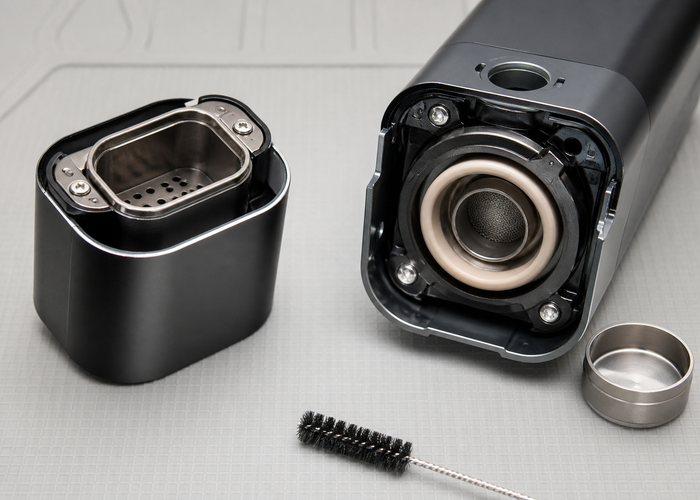
What the heater layout changes
In a direct-contact oven, material near the wall receives heat first. A reasonably even grind and the manufacturer-recommended pack help maintain contact without blocking airflow. Overfilling can compress the load and make the draw tight. Underfilling can reduce contact in some chambers. The right amount is the one described for that oven, not a universal volume copied from another device with a different shape. For the shared coil, chamber and airflow vocabulary, start with our atomizer and heater fundamentals.
Convection asks different questions. Can heated air pass through the whole load? Does the screen stay clear? Is the draw fast enough to cool the heater or slow enough to move useful heat? The manual should provide the operating technique. If the device only performs when a user follows an undocumented ritual, that is a support weakness. A repeatable, modest draw should matter more than producing one unusually dense result.
Hybrid designs complicate the neat split. The chamber may preheat by contact while incoming air adds energy during a draw. That can shorten warm-up and make the session feel familiar, but it also means both wall residue and air-path cleanliness matter. Do not force a hybrid product into a pure category just to make a buying table simpler. Describe what the hardware actually does and how it is maintained. Heating should not be treated as sterilization; review the FDA-affiliated study of plant material heated in a commercial vaporizer.
Heating plant material does not prove that microorganisms, contaminants or residues have been removed. A vaporizer is not a sterilizer. Start with lawful, appropriately stored material from a responsible source, keep the chamber clean and never rely on a high setting to correct poor storage. If material smells musty, shows visible contamination or has uncertain origin, the device should not be used as a rescue step. When residue or restricted airflow complicates the comparison, use the vaporizer cleaning and burnt-taste guide.
Loading and draw technique
Loading technique is easier to learn when one variable changes at a time. Begin with the manufacturer-recommended amount and a moderate setting. Note resistance before heating, then compare the first and later draws. If the load browns strongly at the wall while the center remains pale, contact and packing may be involved. If air channels through one side, distribution or screen position may be the issue.
Stirring is not automatically required, and opening a hot chamber can create its own risks. Follow the specific device instructions. If stirring is permitted, power off, let exposed parts reach a safe temperature and use the provided nonmetal tool. Never dig against a coated surface or push material into air holes. A design that needs constant interruption may be a poor fit for someone who values a simple, contained session. For a measured example of temperature variability, consult the infrared study of heater temperature during simulated draws.
Draw technique should feel controlled, not theatrical. A very hard draw can cool some heaters and pull small particles toward a screen. A very slow draw can reduce airflow and concentrate heat in other layouts. Use the manual's guidance, then judge consistency across several ordinary sessions. One impressive pull says less about ownership than a device that behaves predictably with the same load and routine. Material construction is handled separately in the ceramic versus quartz chamber comparison.
Temperature displays also need interpretation. A number may reflect a sensor near the heater, a chamber target or a preset estimate. It does not promise that every leaf fragment is at that temperature. Airflow, material moisture, pack density and residue all influence local conditions. Treat the setting as a repeatable control within one device, not a laboratory measurement that can be compared directly across brands.
Conduction and convection at a glance
| Question | Conduction tendency | Convection tendency |
|---|---|---|
| How heat arrives | The chamber wall transfers much of the heat directly into material touching it. | Heated air carries energy through the load during the draw. |
| Loading sensitivity | Even contact and a suitable pack influence browning. | Airflow and distribution matter; overpacking can choke the path. |
| Session behavior | The load may continue warming between draws. | More heating may occur while air is moving, depending on the design. |
| Maintenance focus | Chamber walls, corners and retained residue. | Screens, heater inlet and the complete air path. |
Heat consistency, flavor and claims
Flavor claims are especially easy to overstate. A clean chamber at a modest setting generally offers a fairer comparison than a dirty oven at the top of its range. Mouthpiece material, air-path length and residual cleaner can matter as much as the heat-transfer label. If a product review does not control those variables, its verdict may describe maintenance condition rather than conduction or convection. Hardware composition and local hot spots are discussed in this public-health analysis of heating-element composition.
The same caution applies to efficiency. Dark, even residue does not by itself prove that every desired compound was delivered, and lighter material does not automatically mean waste. Without controlled testing, visual browning is a rough maintenance signal, not a chemical assay. Use it to notice hot spots, restricted airflow or a need to adjust the documented load, not to make precise claims about extraction. To compare formats after the heat-path decision, browse the BT Vapor collection.
Heat-up time should include the period required for the chamber and air path to become stable, not merely the first beep. Some conduction ovens continue equalizing after the ready signal. Some convection heaters reach temperature quickly but still depend on a steady draw. Time an ordinary session from loading through safe cooldown. That number is more useful than the fastest advertised warm-up under ideal conditions.
The lowest workable setting is a sensible place to begin, particularly with unfamiliar hardware. Increase gradually within the documented range and stop if flavor turns harsh, the housing becomes unusually hot or the device behaves inconsistently. Repeatedly forcing maximum heat to clear a blockage is poor troubleshooting. A physical restriction needs inspection and cleaning, not more energy. A damaged or unknown air path deserves caution in light of this study of metals associated with vaporizer hardware and aerosols.
Cleaning and long-term ownership
Conduction chambers often collect a ring of residue where the wall meets the load. Once the device is off and cool, a dry brush or swab can prevent that ring from hardening. Corners deserve attention, but metal picks can scratch coatings or deform a screen. Use only the tools and liquids the manufacturer permits, and keep all moisture away from integrated heaters and electronics. The same separate-electronics cleaning boundary is illustrated in our electric vaporizer cleaning routine.
Convection systems move the maintenance focus outward. Screens, inlet holes, heater guards and cooling units can collect fine particles. A chamber that looks clean may still draw poorly because the restriction sits upstream or in the mouthpiece. Inspect the whole air path in sections. Replacing a clogged screen is often safer and faster than scraping it until the mesh changes shape.
Mouthpieces influence both methods. A removable cooling unit may add comfort but also hide condensate in bends and seals. A simple stem can be easier to inspect, though it may require more careful storage. Look through every channel against a bright background and let removable parts dry completely before assembly. Cleaner odor or a trapped droplet means the maintenance job is not finished. Charging practices should follow the FDA battery handling and charging guidance.
Persistent burnt flavor should not be assigned to the heating category immediately. Old residue, a blocked screen, an aggressive setting, a damaged coating or material contacting a hot wall unevenly can all contribute. Clean and inspect first. If a visible chip, crack or lifting surface remains, stop using the chamber and seek the correct replacement rather than testing whether another cycle makes the symptom disappear. For the size and portability tradeoff, read the rig versus pen ownership comparison.
Battery demand and portability
Battery demand often differs because heater mass, insulation and airflow requirements differ. A convection-focused heater may draw substantial power during airflow, while a conduction oven may spend energy holding a chamber at temperature between draws. Capacity alone cannot settle the comparison. Consider how many ordinary sessions the device supports, how long it charges and whether the specified cable and adapter are convenient.
Charging should happen on a hard, clean surface where the device remains visible. Stop using a battery product that swells, smells unusual, becomes unexpectedly hot or shows impact damage. Do not charge in a closed case, on bedding or near flammable material. A device that requires an unusual charger should include it and identify replacements clearly; connector shape is not proof of electrical compatibility. For household storage and damage warning signs, use the U.S. Fire Administration lithium-ion battery advice.
Portability depends on the entire kit. Conduction devices can be compact because the oven and heater are close, but there are compact convection and hybrid products as well. Count the mouthpiece, brush, loading tool, capsules, cable and protective case. A small body with a fragile protruding stem may require more space than a larger device whose mouthpiece stores safely inside the case. A modular multi-format contrast is the HOOLOO 3-in-1 vaporizer.
Air travel adds a separate layer. Battery devices must be protected from accidental activation and packed according to current carrier and aviation rules. Empty and clean the device before packing; do not seal a warm chamber in a case. Protect loose screens and capsules so they cannot reach electrical contacts. Local laws at the origin and destination still apply independently of airline battery rules.
Who should choose which system
Choose conduction when the documented model offers an accessible oven, predictable controls and the session pace you actually keep. It can be a good fit for someone who loads once, uses the chamber steadily and is willing to brush the wall after cooling. Do not choose it merely because the device is cheaper or faster on paper. A badly shaped oven can turn a simple heat path into tedious maintenance. Anyone traveling with a battery device should check the FAA lithium-battery baggage guidance.
Choose convection when you value airflow-led heating and are comfortable learning the device's draw. It can reward an open, evenly distributed load and make between-draw behavior easier to manage in some designs. It is a poor fit when screens are hard to reach, the heater inlet is undocumented or the user dislikes technique-sensitive equipment. The air path must be as maintainable as the chamber. Another format comparison point is the I-MAGMA 2-in-1.
Choose a hybrid when it solves a real routine problem rather than because the label sounds advanced. The combination can offer quick readiness and useful airflow, but it inherits cleaning duties from both sides. Ask where contact heating occurs, where incoming air is heated and which parts are replaceable. A transparent explanation is a better sign than a claim that the device delivers every advantage without compromise.
Whichever method wins, test consistency with notes rather than memory. Record the load, setting, draw resistance, session length, residue pattern and cleaning effort for several uses. Do not change the grind, amount and temperature at once. A repeated pattern reveals whether the device suits you; a single unusually good or bad session usually reveals only that several variables moved together. For a public-health reminder that aerosol is not harmless water vapor, read the CDC overview of vaping devices and aerosols.
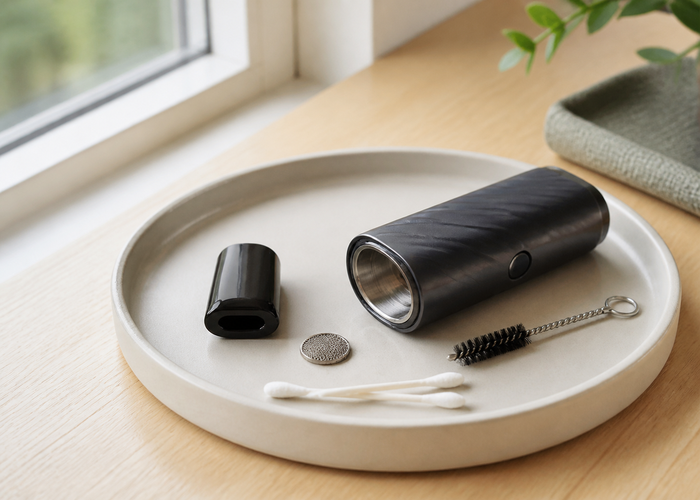
A decision you can verify
The best comparison ends with boundaries. Dry-herb hardware should not be used for concentrates or cartridges unless the manufacturer supplies and documents the exact module. A chamber that fits is not necessarily supported. Keep material categories, cleaning tools and replacement parts labeled. This prevents a modular-looking connector from encouraging an unsafe or messy experiment. To avoid mixing dry-herb and concentrate requirements, compare the separate P2 A concentrate pen.
Before buying, verify five things in writing: the heat-path description, supported material, loading amount, cleaning method and replacement-part route. Then check the charger and lockout. If those answers are clear, conduction versus convection becomes a manageable preference. If they are missing, the problem is not that the technology is complicated; the problem is that the product is poorly documented.
The honest conclusion is modest. Conduction emphasizes chamber contact and often suits a steady, simple session. Convection emphasizes heated airflow and often suits a user willing to manage draw and screens. Hybrid designs live between them. The better device is the one whose complete routine—load, heat, draw, cool, clean, charge and store—can be repeated without shortcuts. Keep the first comparison conservative: use the documented load, begin at a moderate setting, and inspect only after everything has cooled. If the result changes sharply from one session to the next, look for a variable that moved before blaming the heat-transfer category. Consistency is the useful evidence. A short written checklist also makes later cleaning, charging and replacement decisions easier to compare without relying on vague first impressions.